Which metrics should recruiters track?
Data-driven recruiters achieve 30% faster hiring processes. Discover which KPIs truly impact your recruiting success.

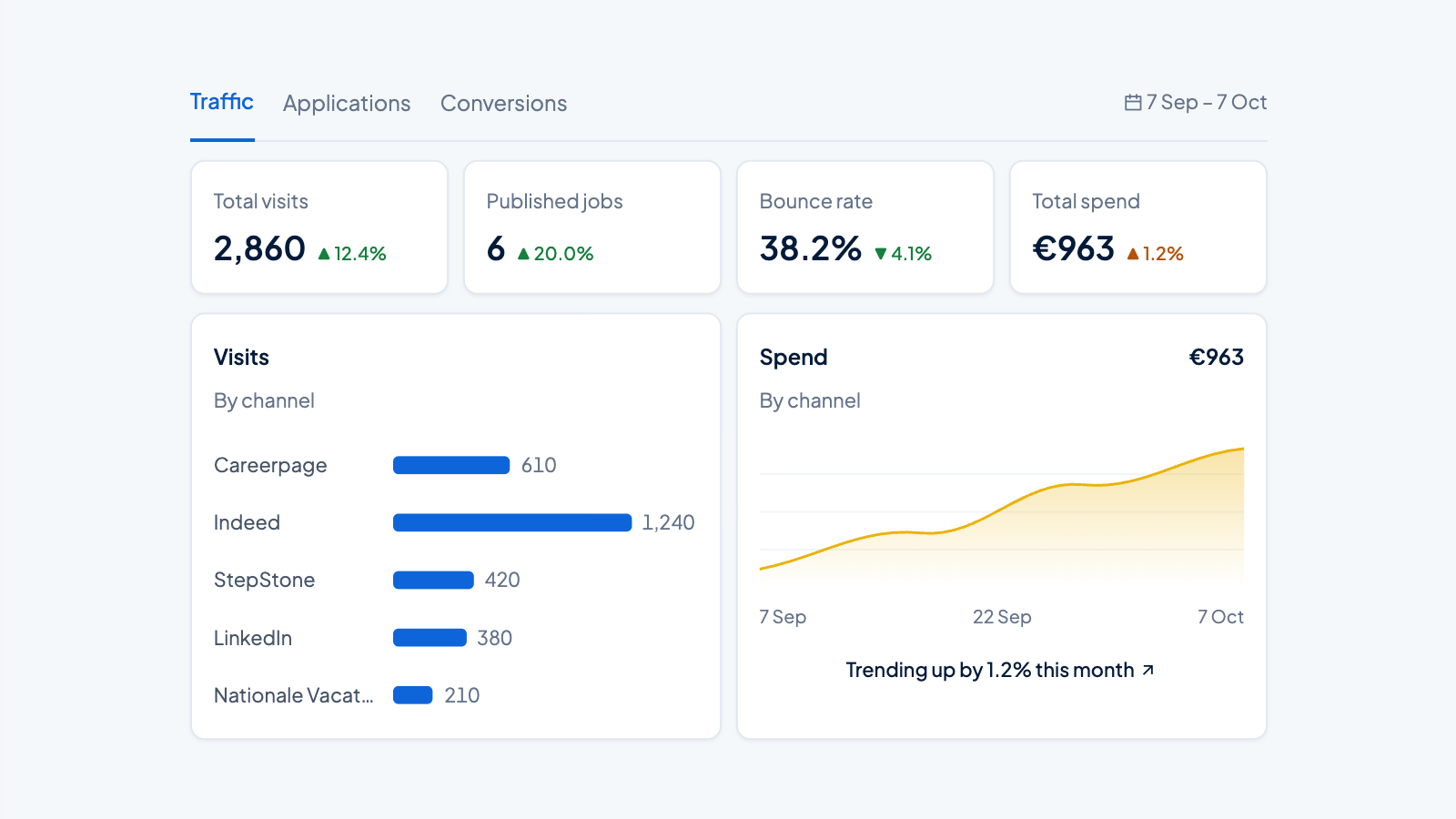
The modern recruitment world is increasingly data-driven. Recruiters who still rely on gut feeling miss opportunities to optimize their processes and achieve better results. Tracking the right recruitment metrics gives you insight into what works and what doesn’t in your hiring process.
With the right HR metrics, you can not only improve your recruiting ROI but also predict where bottlenecks will arise and intervene proactively. This article shows you which recruiter KPIs really matter and how to use them to make better decisions.
Why recruitment metrics are crucial for modern recruiting
Data-driven recruitment is no longer a luxury but a necessity. Companies that use hiring analytics achieve, on average, 30% faster hiring processes and lower cost-per-hire. These metrics help you make objective decisions instead of relying on intuition.
Tracking recruitment data directly impacts your business results. You can see exactly which steps in your hiring process take the most time, where candidates drop off, and which recruitment channels deliver the best ROI. These insights enable you to use your budget and time more effectively.
Moreover, metrics help demonstrate the value of your recruitment team to management. With concrete numbers on efficiency gains and cost savings, you can more easily secure budget for new tools or team expansion.
The most important recruitment funnel metrics every recruiter should know
Your recruitment funnel consists of several stages, each with its own key metrics. Time-to-hire shows how long it takes from job opening to signed contract, while cost-per-hire reflects the total cost per hire.
These hiring funnel metrics give you a complete picture of your process:
- Applicant-to-interview ratio: how many applicants get an interview
- Interview-to-offer ratio: what percentage of interviewed candidates receive an offer
- Offer acceptance rate: how many offers are accepted
- Source effectiveness: which channels produce the most qualified candidates
By monitoring these conversion rates, you quickly identify where your funnel is leaking and can make targeted improvements.
Measuring candidate quality: which KPIs provide real insights
Speed is important, but candidate quality is crucial for long-term success. Quality-of-hire scores combine various factors such as performance ratings, retention rates, and time-to-productivity.
These talent acquisition metrics help assess candidate quality:
- 90-day retention rate: do new hires stay after the probation period
- Manager satisfaction scores: how satisfied are managers with new hires
- Time-to-productivity: how quickly new hires reach desired performance levels
- Internal mobility rate: do hired candidates grow and move internally within the company
These metrics give a much more complete picture than speed and cost alone. They help you adjust your sourcing strategy toward channels that truly deliver quality candidates.
Source-of-hire tracking: which channels deliver the best candidates
Effective source-of-hire tracking shows which recruitment channels yield the best ROI. Job boards, social media, referrals, and recruitment agencies all perform differently depending on your industry and target audience.
Don’t just measure the number of candidates per channel, but also the quality. A channel that generates many resumes but few suitable candidates ultimately costs more time and money than a channel with fewer but better matches.
Optimize your recruitment marketing budget by shifting resources to the best-performing channels. This does require consistent tracking from first contact through to final hire.
Which recruitment metrics lead to bad decisions
Not all metrics are equally valuable. Vanity metrics, such as the total number of applications, can be misleading if quality is low. Focus on actionable insights rather than impressive numbers without context.
Common mistakes when interpreting recruitment data include ignoring seasonal fluctuations, comparing different job types without correction, and drawing conclusions from datasets that are too small.
Avoid bias in your data analysis by always looking at multiple metrics together and considering external factors in your interpretation. A sudden drop in applications, for example, could be due to market conditions rather than your recruitment strategy.
Setting up recruitment dashboards: from data to action
A good HR dashboard transforms raw data into usable insights. Start by identifying your key stakeholders and their information needs. Managers want different numbers than recruiters or finance teams.
Automating reporting saves time and ensures consistency. Choose tools that integrate with your existing systems and enable real-time updates. This prevents you from spending hours manually gathering numbers.
Make sure your dashboards contain actionable insights. Numbers without context or follow-up actions are worthless. Add benchmarks, trends, and recommendations to help your team make better decisions.
How Applyfin helps with recruitment metrics
Applyfin centralizes all your recruitment data in one clear platform, automatically tracking the metrics that matter. Our intelligent dashboards give you real-time insight into your hiring funnel performance and candidate quality.
With our automated tracking, you get:
- Automatic calculation of time-to-hire and cost-per-hire
- Detailed source-of-hire analytics per channel
- Conversion rate tracking through every stage of your funnel
- Quality metrics based on candidate scoring
Ready to take your recruitment metrics to the next level? Discover our features and see how our AI-driven workflows help you achieve better results. Get in touch for a personal demo of our analytics capabilities, or visit our website for more information on how we help recruitment teams manage three times as many candidates with the same resources.