How do you screen candidates faster?
Learn how AI and automation speed up your screening process and deliver 60% cost savings for recruiters.

Finding the right candidates is becoming increasingly challenging in today’s job market. Recruiters and HR professionals receive dozens of applications daily, but the traditional way of screening candidates takes far too much time. While you spend hours poring over resumes and conducting initial interviews, the best talent is moving on to the competition.
The solution lies in optimizing your recruitment screening process. By applying smart techniques and leveraging modern technology, you can drastically reduce the time needed for candidate selection without sacrificing quality. This article shows you how to achieve faster screening and which steps you can take today to improve your hiring efficiency.
Why traditional screening methods are too slow
Manual resume screening is the biggest bottleneck in many recruitment processes. On average, a recruiter spends 6 to 25 seconds per resume, but with high volumes, this can add up to hours per vacancy. The lack of standardized processes means different team members apply different criteria, causing inconsistency and delays.
Traditional screening methods lead to a poor candidate experience. Applicants wait weeks for feedback, causing top talent to drop out and move on to faster employers. The impact on time-to-hire is significant: where modern companies can decide within two weeks, traditional processes often take six to eight weeks.
Time-consuming initial interviews without prior filtering mean recruiters spend a lot of time on unqualified candidates. This leads not only to inefficiency but also to frustration for both recruiters and applicants who turn out not to be a fit for the role.
Which screening techniques deliver the best results
Structured interviews with predetermined questions yield more consistent results than open-ended conversations. Using standard question sets allows you to compare candidates objectively and reach a decision faster.
Skills assessments and practical tests provide direct insight into candidates' actual abilities. This method is especially effective for technical roles, but you can also use situational assignments for commercial positions.
AI-driven pre-screening automates the first selection round by analyzing resumes for relevant keywords, experience, and qualifications. Automated questionnaires can screen candidates upfront on essential requirements, so only qualified applicants move on to the next stage.
Video interviews save travel time and make it possible to speak with more candidates in less time. Asynchronous video interviews, where candidates answer pre-recorded questions, offer extra flexibility for both parties.
How AI and automation accelerate your screening process
Modern recruitment automation uses advanced technologies to drastically speed up the screening process. Resume parsing technology automatically extracts relevant information from cover letters and resumes, making manual data entry obsolete.
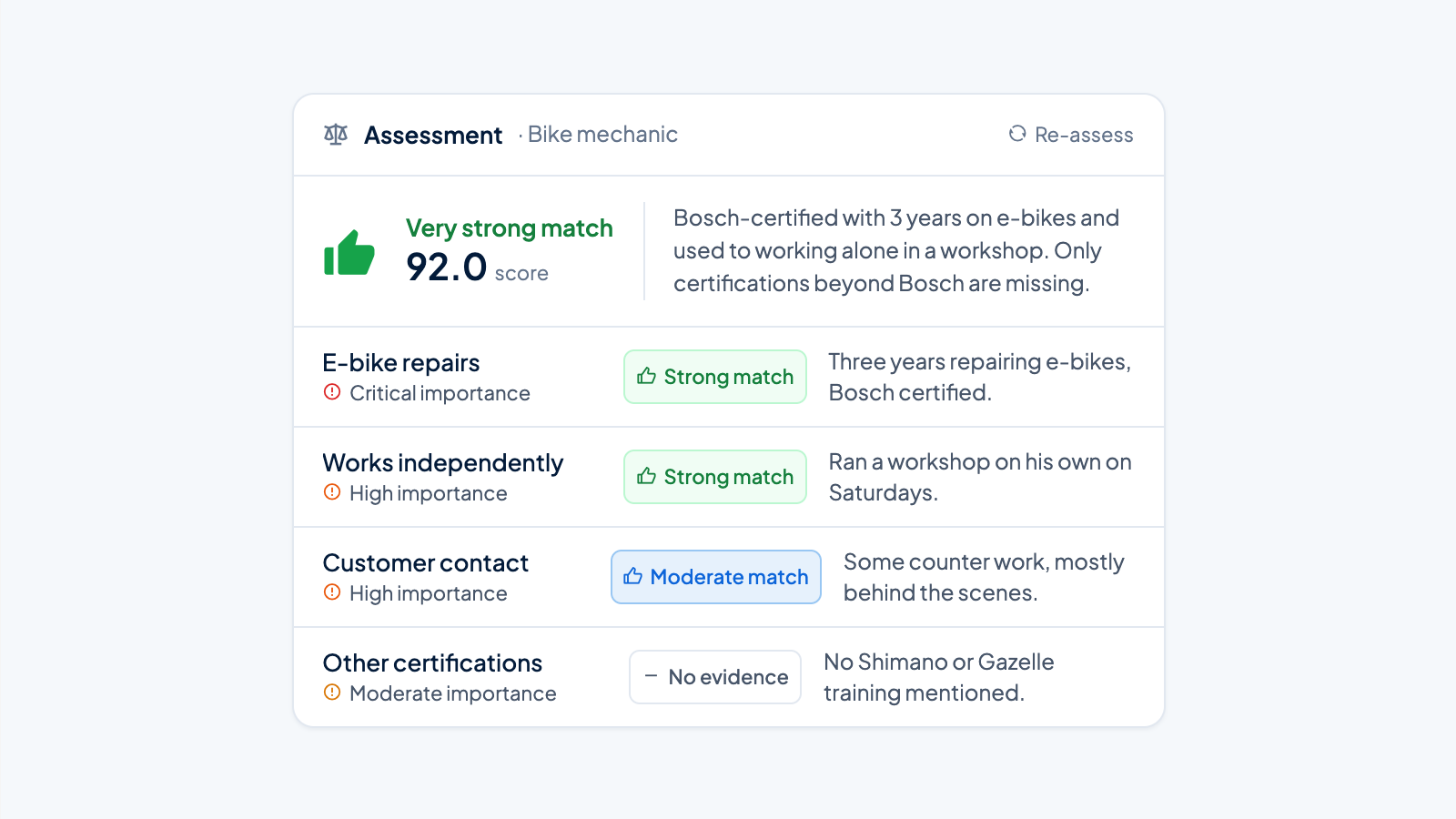
Automatic skills matching compares candidate profiles with job requirements and provides a compatibility score. This helps recruiters identify within seconds which candidates are the best fit for the vacancy.
Chatbot pre-screening automatically asks candidates the right questions about their experience, availability, and salary expectations. This AI screening technology can operate 24/7 and ensures that only pre-qualified candidates move on to human recruiters.
Predictive analytics uses historical data to predict which candidates have the highest chance of success. This technology analyzes patterns in successful hires and applies them to new applicants.
Setting the right screening criteria for different roles
Defining clear must-have versus nice-to-have qualifications prevents you from wasting time on overqualified or underqualified candidates. You should establish specific criteria for each role:
- Technical skills that are absolutely required for daily tasks
- Minimum work experience in relevant sectors or roles
- Soft skills that are crucial for team dynamics and company culture
- Practical matters such as availability, location, and salary expectations
Role-specific screening questions help you quickly differentiate between candidates. For sales roles, you focus on commercial results and customer orientation, while for IT roles, you place more emphasis on technical problem-solving skills.
Balancing technical and soft skill evaluation is essential. A brilliant programmer who cannot collaborate may not fit into your team, while a less experienced candidate with strong learning ability can grow into a top performer.
Common mistakes that slow down your screening
Overly broad job descriptions attract many unqualified applicants, unnecessarily inflating the screening process. Specific and realistic job requirements lead to better matching and less wasted time.
A lack of standardization among recruiters leads to inconsistent decisions and longer turnaround times. Without clear processes and criteria, every screening becomes an individual interpretation.
Insufficient stakeholder alignment causes delays in decision-making. When hiring managers and HR teams have different expectations, discussions arise that hold up the process.
Ignoring candidate feedback is a missed opportunity to improve your process. Applicants who are rejected can provide valuable insights into bottlenecks in your applicant tracking process.
Practical steps to optimize your screening process
Optimizing your recruitment screening starts with a thorough analysis of your current process. Follow these concrete steps to achieve faster screening:
- Document your current process and identify where the biggest delays occur
- Set clear screening criteria for each job category
- Implement standardized question sets and evaluation forms
- Train your team in efficient screening techniques and new tools
- Monitor your performance using metrics such as time-to-hire and candidate satisfaction
Tool selection plays a crucial role in accelerating your screening process. Look for platforms that integrate various screening methods and enable automation. Ensure that new tools integrate well with your existing systems.
Performance monitoring helps you measure the effectiveness of your optimizations. Track how much time you save per vacancy and whether the quality of your hires improves with the new approach.
How Applyfin helps with faster candidate screening
We offer an integrated solution that combines all aspects of modern recruitment screening into one platform. Our AI-driven workflows automate time-consuming tasks, while our intelligent qualification system automatically scores candidates on relevance.
With Applyfin, you can:
- Centralize all candidate data in one clear dashboard
- Use AI screening for automatic resume analysis and matching
- Set up standardized workflows that deliver consistent results
- Manage up to three times more applicants without additional staff
Recruiters using our platform achieve an average of 60% cost savings through improved efficiency. The result: faster decisions, a better candidate experience, and more time for strategic recruitment work.
Ready to revolutionize your screening process? Contact us for a personal demonstration and discover how you can put your recruitment on autopilot.