Free job boards vs paid job boards: where to spend your first €300
For a customer support role in Rotterdam, free boards can bring applications, but a small paid boost on Indeed or LinkedIn might cut time-to-hire. A simple budget split shows where to put your first €300.
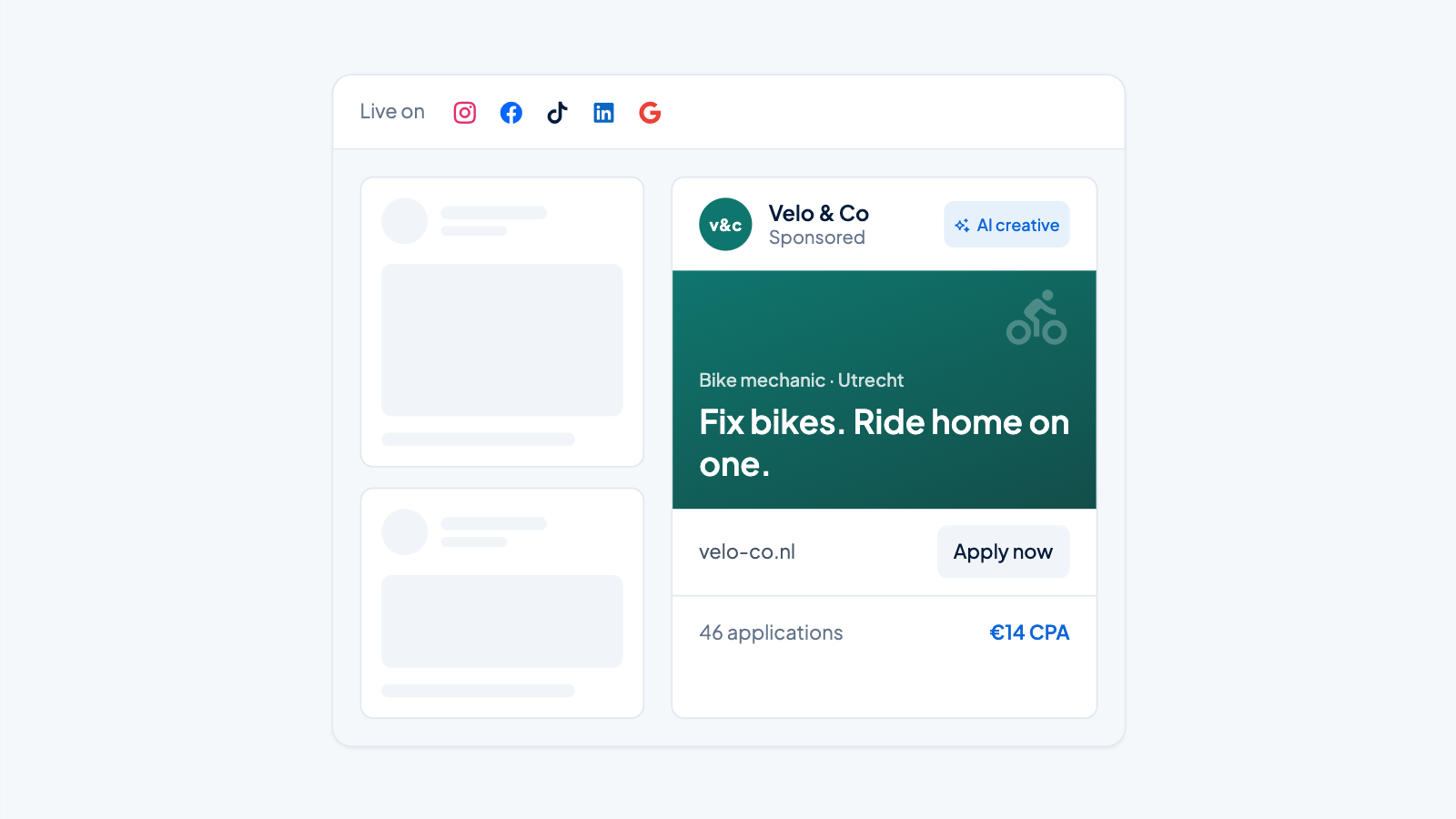
A small HR team in Rotterdam needs a customer support agent. The ad is written, the salary band is set, and the media budget is €300. The only open question: list the role on free job boards and wait, or use the budget for a paid boost on Indeed or LinkedIn? Both can fill the role. The real differences are speed, applicant quality, and how much recruiter time you spend screening. This comparison uses a customer support role in Rotterdam as the working example and ends with a simple budget split and decision rule.
Free job boards: reach without a media budget
Free job boards let you list a job without media spend. Some pull the posting from your career page or ATS, such as Indeed's free tier and Google for Jobs. Others accept direct posts, such as Jobbird and the free tier of Nationale Vacaturebank. A few Dutch sector-specific boards also list customer support roles for free.
After the posting is indexed, it appears in search results. For a customer support role in Rotterdam, a free posting might bring 10 to 20 applicants in week one and 15 to 30 across two to three weeks. These are example ranges, not guarantees. Volume depends on how clear the ad is and how many relevant boards you use.
The main advantage is zero media spend. The cost is your time: writing the ad, posting to several boards, and checking which source actually produced applicants.
Three things improve free board results without spending money:
- Use the job title candidates actually search for. For this role, test "customer support agent", "medewerker klantenservice", and "service desk medewerker".
- Put location and salary in the first two lines. Candidates skip vague ads.
- Post to at least three relevant boards, not just one.
Free boards still have limits. You cannot control where the ad ranks, and you get few targeting controls beyond the text itself.
Paid board campaigns: visibility and speed on demand
Paid job board campaigns mean you pay for prominence. The two common formats for a small budget are Indeed Sponsored Jobs and LinkedIn Job Slots. You set a daily budget, choose a location radius, and add filters for skills or job titles. The platform shows the ad higher in search results or in candidate feeds.
For the same Rotterdam customer support role, a campaign with a €14 to €20 daily budget might bring 30 to 50 applicants in the first week, again an example range. Because you can filter by location, language, and relevant job titles, the share of applicants who pass a first screening step is usually higher than with free boards alone. Paid boards trade money for speed and a tighter funnel.
Before launching a paid campaign, set three controls:
- A daily budget you can afford to lose for one week.
- A location radius that matches who can realistically commute to Rotterdam.
- A pause rule. Example: if cost per screenable applicant goes above €20, stop and review the ad or targeting.
Free vs paid: the differences at a glance
|
Criterion |
Free boards |
Paid boards |
|---|---|---|
|
Cost |
€0 media spend; time to post and track |
€200 to €300 for a short campaign, e.g. 7 to 14 days |
|
Typical weekly applicants, Rotterdam customer support |
Example: 10 to 20 in week one; 15 to 30 over two to three weeks |
Example: 30 to 50 in week one |
|
Applicant quality, initial screening |
Example: 30 to 50% pass a first check; many miss language or availability requirements |
Example: 50 to 70% pass; targeting filters out some mismatches |
|
Time to first qualified candidate |
2 to 4 weeks |
3 to 7 days |
|
Targeting controls |
None or limited; location and job title come from the ad text |
Location radius, skills, job titles, sometimes competitor targeting |
|
Admin effort to maintain |
Manual posting or a multiposting tool; tracking sources takes discipline |
Campaign setup and daily monitoring; can be combined with free postings in one dashboard |
Application quality: who actually passes your screening?
Free boards cast a wide net. For a customer support role that requires Dutch and English plus rotating shifts, expect many applicants to miss at least one must-have. Example: if 20 free applicants arrive, you might clear 6 to 10 after a simple two-question check. The rest cost screening time without moving you closer to a hire.
Paid campaigns let you filter before the CV reaches you. Indeed Sponsored Jobs can target skills and location radius. LinkedIn Job Slots can narrow by job title and location. The result is a higher share of applicants who pass a first check. Example: if 20 paid applicants arrive, you might clear 10 to 14. You are paying to reduce reviewer time, not just to get more CVs.
Before the ad goes live, write the two or three must-have checks you will use on every application. For this role, that is Dutch and English, availability for rotating shifts, and location within commuting distance of Rotterdam. A paid campaign will not fix a vague ad, but it can stop mismatched candidates from entering the funnel.
A simple screening checklist could look like this:
|
Check |
Must-have for this role |
|---|---|
|
Dutch level |
At least B2, spoken and written |
|
English level |
At least B1, spoken and written |
|
Availability |
Rotating shifts, including evenings and weekends |
|
Location |
Within 30 km of Rotterdam or willing to relocate before start |
Use the same checklist for free and paid applicants. The difference is how many applicants you have to reject without an interview.
Time-to-fill: when every day counts
Free boards lose the first five to seven days to indexing and organic visibility. The first qualified applicant often appears in week three or four. If the team is already stretched, that wait hurts service levels and existing staff.
A paid Indeed Sponsored campaign can deliver the first screenable applicants within 48 hours. A shortlist of three to five people who meet the must-haves can form within a week, provided the ad itself is well written. LinkedIn Job Slots work similarly, though the audience tends to be smaller and more professional.
For a customer support role in Rotterdam, removing two weeks from the vacancy often justifies a €200 to €300 spend. As an example: if a two-week delay means 40 hours of overtime for the current team at €40 per hour, that is €1,600. A €200 campaign that removes that delay saves money. If you have four or more weeks to fill and no acute staffing pressure, free boards alone can be enough.
Effort and targeting control
Free boards require manual posting or a multiposting tool. Tracking which applicants came from which board takes discipline. Without UTM parameters or source tags, you guess which board delivered the hire. Use source tags like source=jobbird or source=indeed_sponsored on career page links, or use a system that applies them automatically.
Paid campaigns give granular controls: location radius, skill requirements, and audience filters. They also demand daily attention. Watch cost per applicant and pause a campaign that burns budget without producing screenable candidates. The admin work shifts from manual posting to campaign monitoring.
Applyfin combines free and paid distribution in one dashboard. You set up both tracks in a single flow, see applicants by source, and get a cost per qualified candidate without building spreadsheets. This is useful when the budget is €300 and you need to move money between channels fast. Learn more about how to publish job postings on multiple job boards and what job board distribution software does.
How to split your first €300 on job boards
Start every role by posting on all relevant free boards. For a customer support job in Rotterdam, that means at least Indeed free, Google for Jobs via your career page, Jobbird, and any Dutch sector boards you know. This costs nothing and builds a baseline pipeline.
Then split the €300 across two small paid experiments:
- €200 on an Indeed Sponsored Job for 14 days, with a daily budget of about €14. Target a 25 km radius around Rotterdam and add skill filters for customer service and languages if the platform allows.
- €100 on a LinkedIn Job Slot for 7 days. Target Rotterdam and nearby cities, and use job titles like customer support agent, medewerker klantenservice, and service desk medewerker.
After seven days, compare what each channel delivered. Count only applicants who pass your initial screening. If LinkedIn brought three qualified candidates for €33 each and Indeed brought eight for €25 each, the next budget should go to Indeed. If one channel delivered zero qualified applicants, stop it and move the remaining budget to the channel that worked.
If you use Applyfin, you can manage the free postings and paid campaigns in one flow. The platform tracks cost per applicant per channel, so you adjust spend without manual tallying. For measuring return, read how to measure recruitment marketing ROI.
When free boards are enough (and when they aren't)
Free boards alone can work when three conditions hold:
- You have four or more weeks to fill the role.
- The local candidate pool is large, as it is for customer support in Rotterdam.
- Your team can handle a slower pipeline and screen a wider funnel.
A paid boost is the smarter first step when:
- You need someone in the door within 14 days.
- The free listing produced zero screenable applicants in the first seven days.
- The role requires a specific language, availability, or skill filter that free boards cannot enforce.
The decision rule: if organic applications have not produced a qualified shortlist of at least three people after seven days, move at least €200 to a paid boost immediately. Do not wait another week hoping the free boards will pick up. They might, but the cost of delay is usually larger than the cost of the campaign.
Next step: run a two-track experiment
Post the role on free boards on day one. On the same day, launch a small paid campaign with a daily cap you can afford to lose. For the next two weeks, track one number per channel: cost per qualified applicant, not total applicants. Let that number tell you where the next €300 goes. After one role, you will have a repeatable playbook for the next one.