Which recruitment data can you collect automatically?
Modern recruitment platforms automatically collect candidate details, performance indicators, and interaction data without manual entry. From CV parsing to behavioral metrics: AI technology extracts information from applications and stores it directly in structured databases. This saves recruiters hours each day, eliminates typos, and enables data-driven decision-making. Discover which specific data you can automate and how you can manage up to three times more candidates with the same team.

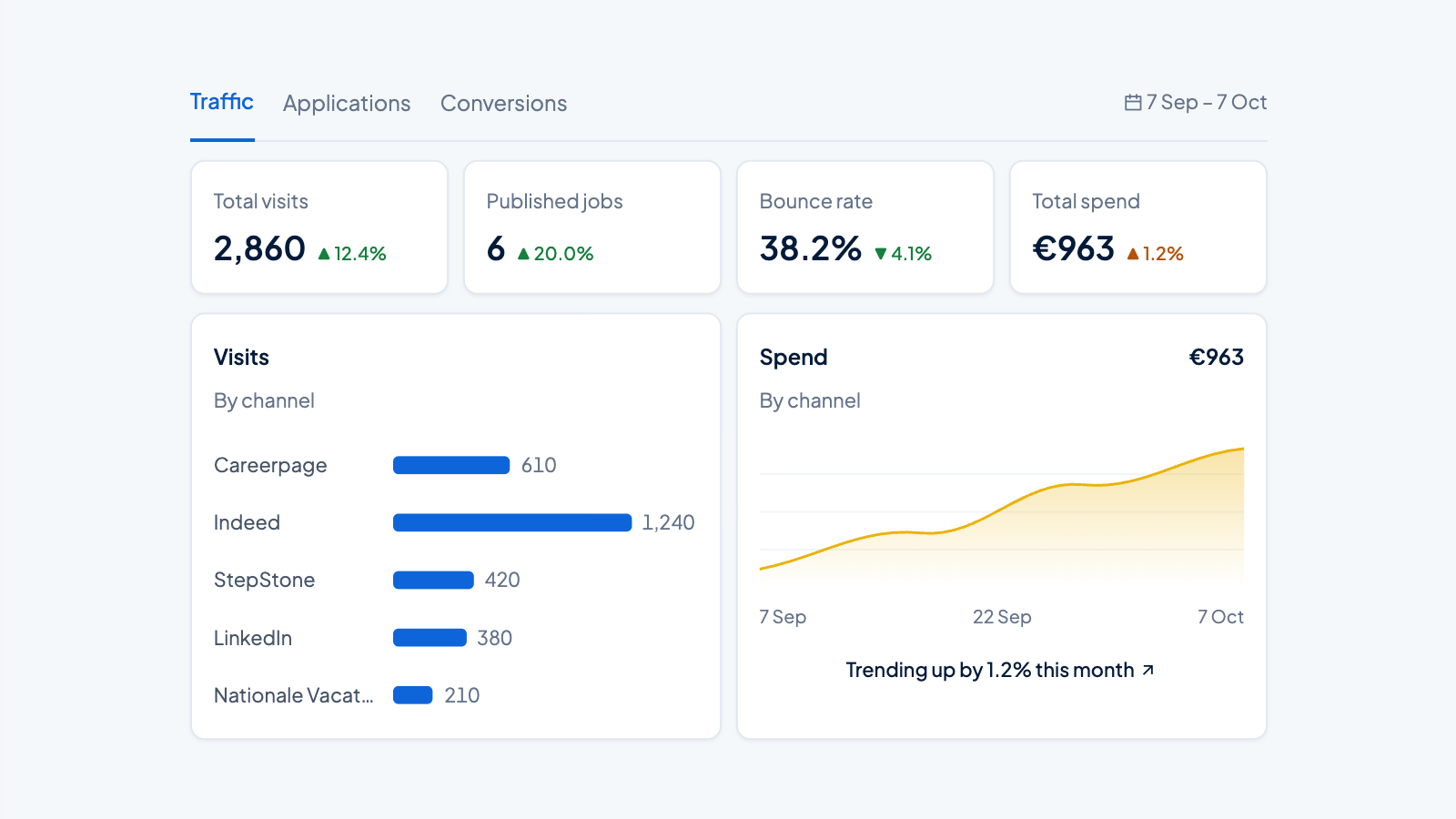
Automatic recruitment data collection involves capturing candidate information, performance indicators, interaction data, and behavioral metrics without manual entry. Modern recruitment platforms use AI and parsing technology to extract information from resumes, applications, and communication and store it directly in structured databases. This saves recruiters a huge amount of time and increases the accuracy of your hiring data, allowing you to manage more candidates with less administrative burden.
Which basic candidate data can you collect automatically?
You can automatically collect all fundamental candidate information: contact details, resume content, work experience, educational background, skills, and application dates. Modern ATS systems extract this data directly from submitted documents and online forms and store it in a structured way in your recruitment database. This eliminates the need for recruiters to manually retype or copy data.
Automatic collection starts as soon as a candidate applies. The system reads resumes and cover letters, recognizes relevant data points, and automatically categorizes this information. Think of name, email address, phone number, place of residence, current position, past employers with dates, obtained diplomas and certificates, and listed competencies.
These basic data form the foundation of your candidate profile. By collecting them automatically, you avoid typos and ensure that all information is recorded consistently. Recruiters can start evaluating candidates right away instead of spending time entering data into different systems.
How does automatic data collection work in the hiring process?
Automatic data collection uses parsing technology that analyzes documents and recognizes and extracts relevant information. This technology works together with AI and machine learning to convert unstructured data from resumes, cover letters, and online profiles into usable, structured information in your recruitment database. The process takes place in real time as soon as a candidate applies or makes contact.
The system goes through several steps when collecting data:
- Receipt of application materials via various channels (job site, email, social media)
- Automatic analysis of documents, interpreting text, formatting, and context
- Recognition of data fields such as names, dates, companies, and education
- Extraction and categorization of relevant information per data field
- Storage in a structured database with links to the full profile
- Automatic enrichment with data from external sources like LinkedIn
AI in recruitment processes makes it possible to work increasingly accurately. Machine learning algorithms learn from previous applications and improve their ability to interpret information correctly. Integrations with job sites and social media platforms ensure that data comes in automatically regardless of where candidates apply.
Which performance indicators and metrics can you track automatically?
You can have all key recruitment KPIs measured and reported automatically. Time-to-hire, cost-per-hire, source of hire, applicant-to-interview ratio, candidate drop-off rates, and quality of hire are tracked continuously without manual calculations. Modern recruitment platforms record every step of the hiring process and automatically generate reports that give insight into the effectiveness of your recruitment efforts.
These automatically collected metrics give you direct answers to important questions:
- Time-to-hire: how many days between posting the job and accepting an offer
- Cost-per-hire: what are the total costs per hired candidate, including advertising and recruiter time
- Source of hire: which channels produce the most and best candidates
- Conversion rates: how many applicants reach each stage of your funnel
- Drop-off points: where do candidates drop out in your application process
- Recruiter productivity: how many candidates does each recruiter manage effectively
Data-driven decision-making becomes possible because you no longer have to guess which approach works. AI recruitment tasks also include identifying patterns in your data, enabling you to predict which candidates are most promising and where your budget is best spent.
What are the benefits of automatic recruitment data collection?
Automatic data collection saves recruiters an average of several hours a day that would otherwise be spent on manual entry. You increase the accuracy of your data because human typing errors are eliminated, improve your GDPR compliance through structured data storage, and ensure faster response times to candidates. This enables recruiters to manage more candidates simultaneously and focus on personal contact and strategic recruitment tasks.
The concrete benefits translate directly into better results:
Time saving: No manual copying of data means recruiters can focus on conversations with candidates and hiring managers. What used to take hours per job opening now happens in seconds.
Increased accuracy: Automatic systems make no typos and interpret data consistently. You get reliable information on which to base decisions without worrying about incorrect data.
Better compliance: GDPR requirements are automatically followed because systems precisely track which data you collect, where it is stored, and when it must be deleted. This protects your organization against privacy violations.
Improved candidate experience: Candidates receive faster responses because their data is available immediately. AI recruitment processes make it possible to give an initial assessment within minutes of application.
Scalability: You can easily manage more job openings and candidates without proportionally hiring more recruiters. This makes AI recruitment cheaper and more efficient as you grow.
Which interaction data and behavioral data can you track automatically?
You can automatically record all interactions between candidates and your recruitment process: email open rates, click behavior on job pages, time spent reading information, application completion rates, complete communication history, and interview appointment dates. This behavioral data gives you valuable insight into how genuinely interested candidates are and where your recruitment funnel can be improved.
Behavioral data helps you understand what works and what doesn't in your hiring approach. If candidates drop off en masse at a particular question in your application form, you see that directly in the data. If certain emails are never opened, you know you need to adjust your subject line.
Important interaction data that are automatically tracked:
- Open rates and read time of recruitment emails
- Clicks on links to job postings, company information, or application forms
- Time spent on various pages of your career site
- Start rate vs. completion rate of applications
- Response speed to messages and invitations
- Engagement with WhatsApp messages and other communication channels
- No-show rates at scheduled interviews
AI recruitment tasks are enriched by this behavioral data. Systems can predict which candidates are likely to respond to a message or which candidates are truly interested versus those just looking around. This makes AI recruitment faster because you can prioritize the most engaged candidates.
How do you start automatically collecting recruitment data?
Start by selecting a recruitment automation platform that fits your organization and volume. Determine which data is most valuable for your specific hiring process and ensure your system can collect this information. Integrate the platform with your existing tools such as your job sites and email system, train your recruitment team in its use, and set up dashboards that display the metrics that matter to you.
Implementation goes smoothest when you proceed step by step. Start with automating the most time-consuming tasks, like collecting basic data from resumes. Then expand to automatically tracking metrics and interaction data. Give your team time to get used to the new way of working.
Practical steps for successful implementation:
- Evaluate your current recruitment process and identify bottlenecks
- Determine which data you need for better decision-making 3 . Select a platform that can automatically collect this data
- Test the system with a small set of job openings before fully switching over
- Train your recruiters in interpreting and using the collected data
- Set up reports that are automatically generated and shared 7 . Continuously optimize based on the insights you gain
We help organizations set up automated recruitment workflows that deliver immediate results. Our experience is that recruiters can manage noticeably more candidates within a few weeks because administrative tasks largely disappear. The combination of automatic data collection and AI support makes it possible to process up to three times more applicants with the same team.
Want to know how automatic data collection can work specifically for your organization? Discover how our platform transforms your recruitment process or get in touch for a personal consultation about the possibilities for your situation.