How can AI make sourcing more organized?
AI sourcing transforms chaotic recruitment workflows into structured processes with one central hub for all candidate information. Through automatic screening, real-time pipeline visualization, and integrated data management, you prevent qualified candidates from slipping through the cracks. Recruiters spend less time on admin and more on meaningful conversations, while AI ensures consistent qualification and transparency for the entire team. Discover how to get started step by step with AI-driven sourcing.

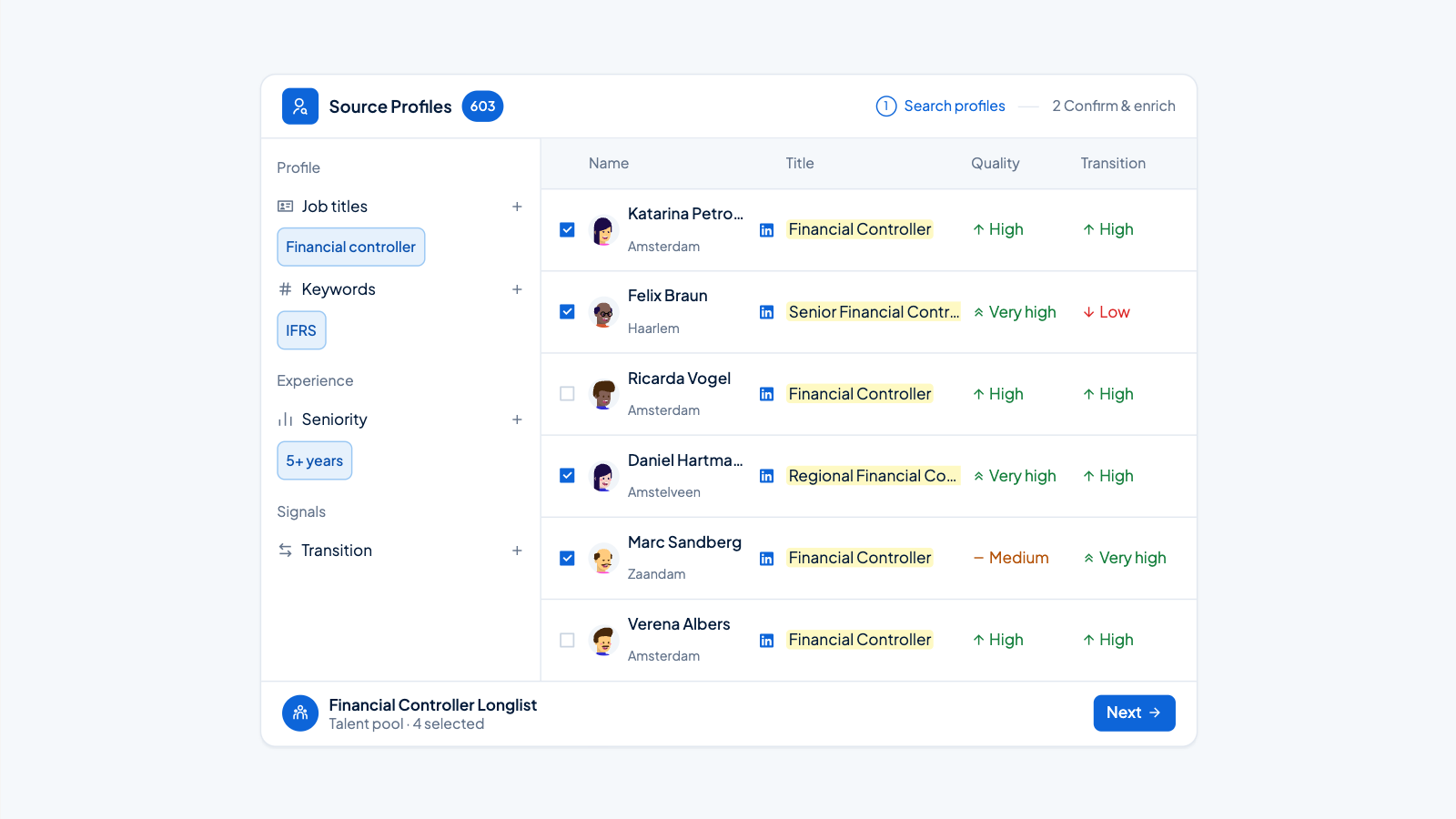
AI sourcing makes the recruitment process more manageable by centralizing candidate data, automating manual tasks, and providing real-time visibility into your hiring pipeline. Instead of working across scattered tools and spreadsheets, you get one central hub where all candidate information comes together. AI-driven workflows automatically screen applicants, score qualifications, and give you immediate insight into where each candidate is in the process.
What is AI sourcing and why is it important for recruiters?
AI sourcing is the use of artificial intelligence to find, assess, and manage candidates within the recruitment process. It transforms traditional manual sourcing into automated workflows that use data to make better decisions.
For recruiters handling dozens or hundreds of applications daily, this represents a fundamental shift. Where you used to spend hours manually reviewing resumes and tracking candidate statuses across different systems, AI in recruitment processes takes over these repetitive tasks.
Its relevance lies primarily in scalability. Recruitment agencies and corporate TA teams face ever-growing volumes of applicants, while expectations for speed and quality keep rising. AI sourcing enables you to manage more candidates effectively without investing proportionally more people or time. It ensures that no qualified candidate slips through the cracks because you lose track.
How does AI make candidate sourcing more manageable?
AI creates structure and visibility in your sourcing process through several mechanisms that work together. The central principle is that all candidate information is collected, organized, and made accessible in one place.
The main ways AI recruitment tasks become more manageable:
- Centralized data management: All resumes, emails, WhatsApp messages, and conversations are automatically linked to a single candidate profile, so you don't have to search across different systems
- Automated qualification workflows: AI screens and scores candidates based on predefined criteria, so you immediately see who's the best fit
- Pipeline visualization: Real-time overview of where each candidate is in the process, from first contact to hire
- Reduced administrative burden: Automatic updates, reminders, and follow-ups ensure you spend time on meaningful work instead of admin
- Structured data collection: Standardization of how candidate information is captured, making comparison and reporting easier
These elements ensure that at any moment you know how many candidates there are, where they are in the process, and what action is needed. It prevents candidates from being forgotten or you from doing double work.
What problems does AI sourcing solve in the recruitment process?
AI sourcing tackles concrete pain points that recruitment professionals experience daily. These problems become especially noticeable in organizations with high application volumes or multiple open positions at once.
- Losing track at high volumes: When you receive dozens of applications a day, manual tracking becomes unworkable. AI automatically sorts and prioritizes, so you always know which candidates need attention and which have already been handled.
- Fragmented tools and data: Many teams work with separate systems for email, resume storage, scheduling, and communication. AI sourcing integrates these sources into one platform, so you no longer have to switch between different applications to get a complete picture.
- Lack of pipeline transparency: Without a clear system, team members don't know where candidates are or who is responsible for the next step. AI recruitment processes make each candidate's status visible to the whole team.
- Time-consuming manual screening: Reviewing resumes for basic qualifications takes hours that could be better spent on personal contact with promising candidates. AI takes over this initial selection with consistent criteria.
- Difficulty scaling: Traditional methods require more people to manage more vacancies. AI-driven sourcing lets you process significantly more candidates with the same team, making AI recruitment cheaper and more efficient.
What's the difference between traditional sourcing and AI-driven sourcing?
The difference lies in workflow, time investment, and scalability. Traditional sourcing is labor-intensive and linear, while AI-driven sourcing works in parallel and adapts to volume.
With traditional sourcing, you manually go through each step: posting jobs on different platforms, collecting resumes in your inbox or via forms, reviewing each resume individually, making notes in spreadsheets, contacting candidates manually, and updating statuses in separate systems. This process scales poorly because each additional candidate demands proportionally more time.
With AI-driven sourcing, you automate the workflow: jobs are managed centrally and distributed automatically, all applications come into one platform regardless of the channel, AI screens and scores candidates immediately upon arrival, qualified candidates are automatically forwarded to the right recruiter, and the system tracks the pipeline with real-time updates.
The practical difference for recruiters is that traditional methods force you to work reactively, spending most of your time on admin and organization. AI sourcing makes you proactive: you spend time having conversations with the best candidates instead of searching for who they are. This explains why AI recruitment delivers results faster without sacrificing quality.
In terms of candidate quality, AI delivers more consistent results because human bias and fatigue have less influence. Screening happens according to fixed criteria that you define, applied to every candidate without exception.
How do you start with AI sourcing in your recruitment workflow?
Transitioning to AI sourcing doesn't require a complete restart of your process. You can start step by step by first having one job or team work with an automated system, evaluate the results, and then expand.
Start by identifying which AI recruitment tasks have the biggest impact on your situation. For most teams, that's candidate screening and pipeline management. Choose a platform that supports these core functions well and integrates with your existing systems.
We've developed our recruitment platform to make this transition as smooth as possible. It centralizes job management, tracks every applicant from first contact to hire, and uses AI to automate screening and scoring. This allows recruiters to manage more candidates without the quality of interaction declining.
Practical implementation starts with setting up your jobs in the system and defining qualification criteria. From that point on, the platform takes over data collection, screening, and pipeline management. Your team gets a centralized overview where all candidate information comes together, regardless of whether someone applies via email, a web form, or WhatsApp.
Change management is more important than technology. Make sure your team understands how AI supports their work rather than replaces it. The time freed up by automation is invested in personal contact with candidates and strategic hiring decisions.
If you want to explore how AI sourcing works specifically for your situation, you can contact us for a practical demonstration. We'll show you how the platform can improve your current workflow and what results you can expect.
Investing in AI-driven recruitment pays off through more efficient processes, a better candidate experience, and the ability to grow without proportionally more resources. More information about our approach can be found on our homepage, where we explain how recruitment on autopilot works in practice.