How does AI candidate qualification compare to traditional screening?
AI-driven candidate qualification uses machine learning and natural language processing to automatically screen and rank applicants. This recruitment technology analyzes resumes and cover letters, compares them to job requirements, and gives objective scores. The result? Recruiters process three times as many candidates, save hours of manual screening, and identify the best matches faster. The technology doesn't replace human judgment, but automates repetitive tasks so recruiters can focus on valuable candidate contact and strategic decisions.

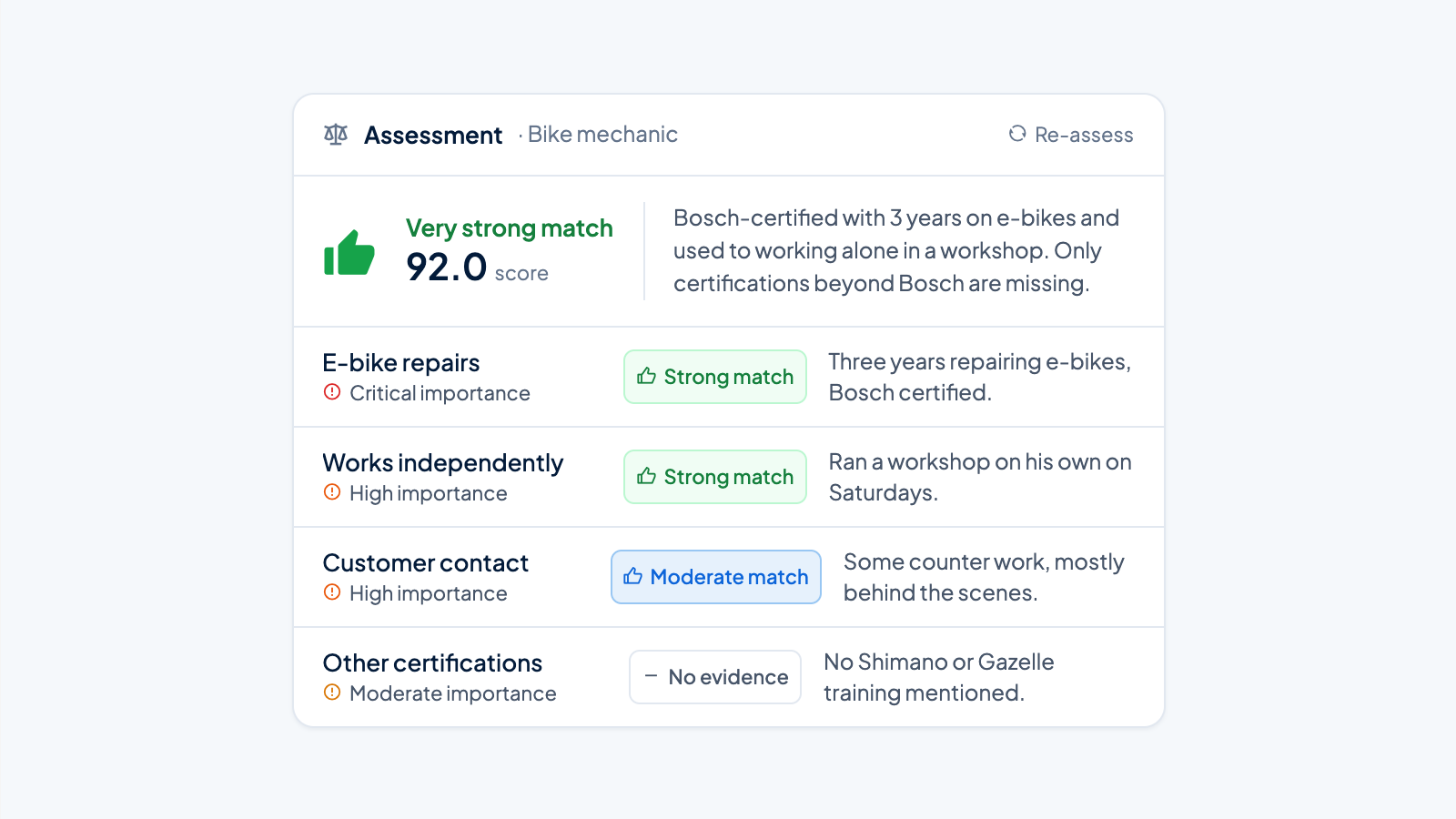
AI-driven candidate qualification uses machine learning and natural language processing to automatically assess applicants against job requirements. The system analyzes resumes, cover letters, and other application data, compares them to job profiles, and scores each candidate. This approach lets you screen large volumes of applications quickly and consistently, so recruiters can focus on the most suitable candidates.
What exactly is AI-driven candidate qualification?
AI-driven candidate qualification is a recruitment technology that applies artificial intelligence to automatically evaluate and rank applicants. The system uses machine learning algorithms and natural language processing to analyze resumes, cover letters, and other candidate information and compare them to the requirements of a vacancy.
Unlike traditional manual screening, where a recruiter reviews every resume individually, AI in recruitment processes handles hundreds of applications in a fraction of the time. The technology identifies relevant work experience, education, skills, and other qualifications and turns them into an objective score.
At its core, AI recruitment tasks consist of recognizing patterns in successful applicants and applying those insights to new candidates. This doesn’t mean human judgment disappears—recruiters can spend their time more effectively on conversations and relationship building instead of administrative screening.
How does AI-driven candidate qualification work in practice?
The AI qualification process follows a clear workflow that integrates seamlessly with existing recruitment activities:
- Data collection: The system pulls in all application data, regardless of the channel (email, web form, WhatsApp). everything is merged into a single candidate profile.
- Parsing and structuring: AI reads resumes and cover letters, identifies relevant information such as work experience, education, skills, and certifications, and structures this data into a uniform format.
- Matching and analysis: The system compares the candidate profile with the job requirements and desired qualifications. Natural language processing helps recognize synonyms and related terms.
- Scoring and ranking: Candidates receive a qualification score based on how well they meet the vacancy requirements. This score helps recruiters prioritize.
- Integration with the ATS: The results appear directly in the applicant tracking system, where recruiters can take further actions like sending interview invitations or rejections.
This automated workflow means AI recruitment processes run faster without sacrificing assessment quality. Recruiters remain fully in control and can always intervene manually when needed.
What benefits does AI qualification offer recruiters and hiring managers?
AI qualification delivers concrete improvements in both the efficiency and quality of the hiring process. The key benefits are:
- Massive time savings: What normally takes hours of manual screening happens in minutes. Recruiters can focus on valuable human interaction instead of administrative work.
- Higher throughput: You can manage three times as many applicants without additional staff. This is critical in high-volume recruitment sectors such as sales, service, and construction.
- Consistent evaluation: Every candidate is assessed in the same way using the same criteria, leading to fairer comparisons and better decision-making.
- Faster time-to-hire: By automating AI recruitment tasks, the time between application and invitation is significantly shortened, improving the candidate experience.
- Better candidate quality: Objective scoring helps identify talented candidates who might be overlooked in manual screening.
- Lower hiring costs: Less time per vacancy and higher success rates make AI recruitment more cost-effective than traditional methods.
These benefits make the difference between an overwhelmed recruiter struggling to keep up and an efficient team that can proactively approach talent and make better hires.
What is the difference between AI qualification and traditional candidate screening?
The contrast between AI-driven and traditional screening becomes clear when you compare various aspects side by side:
Speed and scalability: Traditional screening requires a recruiter to manually read and evaluate every resume, which is time-consuming when a vacancy attracts dozens of applications. AI processes the same volume in a few minutes, making AI recruitment faster and high volumes manageable.
Consistency and objectivity: Human judgment varies with experience, fatigue, and unconscious bias. AI applies the same criteria consistently to every candidate, producing fairer comparisons and more transparent decisions.
Resource allocation: Manual screening ties recruiters to repetitive administrative tasks. AI qualification automates these tasks, allowing recruiters to apply their expertise where it really counts: conducting interviews, building relationships, and making strategic decisions.
Approach and control: In traditional screening, the recruiter is fully responsible for each step. With AI, the recruiter stays in control while receiving support in the form of pre-selected candidates and data-driven insights. It is not a replacement but an amplification of human expertise.
Both methods have their place, but AI qualification offers clear advantages for roles with many applicants and for organizations that want to increase recruitment efficiency without compromising on quality.
How do you start implementing AI qualification in your hiring process?
Switching to AI-driven qualification requires a thoughtful approach. Start by mapping out your current recruitment challenges: where are you losing the most time, which vacancies attract many applicants, and where are you missing candidates?
Next, assess whether your organization is ready for automation. Do you have clear job profiles and selection criteria? Are your job descriptions clearly formulated? This foundation is essential for effective AI qualification, because the system works based on the requirements you provide.
When evaluating recruitment automation platforms, it is important to look for functionality that fits your way of working. Seek systems that centralize all application channels, automatically enrich candidate profiles, and integrate with your existing tools.
When reviewing platform features, pay attention to aspects like the quality of CV parsing, the flexibility of scoring rules, and the degree to which you can adjust criteria yourself. A good system grows with your needs and learns from feedback.
Prepare your team for the change by clearly communicating what AI qualification does and does not do. The goal is to relieve recruiters of repetitive work, not to replace human judgment. Training helps the team gain confidence in the technology and use it optimally.
Ideally, start with a pilot for one or a few high-volume vacancies. This gives you insight into how the system performs and where adjustments are needed before rolling it out to all vacancies.
Want to know how AI qualification could work specifically for your organization? Get in touch to discuss your situation and discover the possibilities for improving your recruitment processes.
AI-driven candidate qualification represents a significant step forward in modern recruitment. It combines speed and scalability with consistent, objective assessment, enabling recruiters to work more effectively and make better hiring decisions. By automating administrative tasks, it frees up space for what truly makes recruitment valuable: human connection and strategic talent management.