What are the most important recruitment KPIs?
Discover the 8 essential recruitment KPIs that HR teams need for data-driven recruitment and better results.

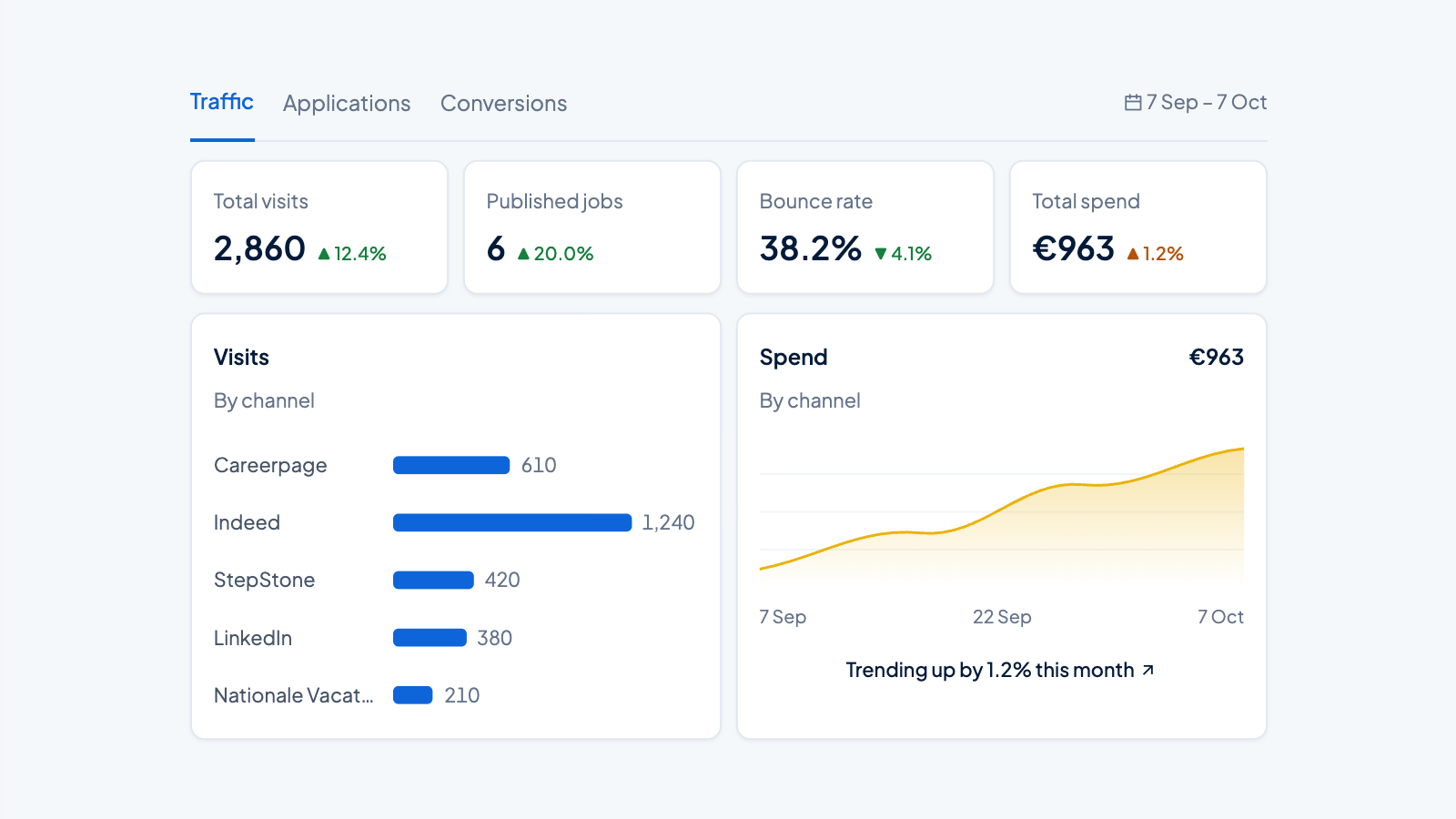
In the modern world of recruitment, everything revolves around data and measurable results. Recruiting teams that want to be successful can no longer rely on gut feeling alone. They need concrete recruitment KPIs to measure and improve their performance. These performance indicators provide insight into what is and isn’t working in the hiring process, from the first application to the final hire.
Measuring the right recruitment metrics helps HR departments work more efficiently, save costs, and attract better candidates. Whether you work for a recruitment agency or a corporate HR department, understanding and applying these KPIs can make the difference between an average and an excellent recruiting team.
In this article, you’ll discover which hiring KPIs really matter, how to calculate them correctly, and which pitfalls to avoid when measuring your recruitment performance.
Why recruitment KPIs are crucial for modern recruiting teams
Data-driven recruitment is no longer a luxury but a necessity. Companies that base their hiring processes on concrete HR metrics perform significantly better than organizations that work on intuition alone.
Using recruitment performance indicators offers several advantages. First, you gain insight into the efficiency of your hiring process. You see exactly where candidates drop off, which sources deliver the best results, and how much time and money you spend on each new employee.
Additionally, KPIs help with cost savings. By measuring where your budget goes, you can discontinue inefficient channels and invest more in what works. Many organizations discover they can save up to 40% on their hiring costs by using data more intelligently.
Metrics are also indispensable for optimizing your hiring process. They show which steps in your process take too long, where candidates experience frustration, and how you can improve the overall candidate experience.
The 8 most essential recruitment KPIs every HR department should measure
Not all hiring metrics are equally important. These eight KPIs form the foundation of an effective recruitment dashboard:
- Time-to-hire: the time between posting a job and accepting an offer. An average of 20 to 30 days is normal for most roles.
- Cost-per-hire: total costs divided by the number of hired candidates, including advertising costs, recruiter time, and tooling.
- Quality of hire: measures new employees’ performance after 6 to 12 months via performance reviews and retention rates.
- Candidate experience score: feedback from candidates about the application process, usually measured via surveys.
- Source effectiveness: which channels deliver the best candidates, from LinkedIn to referrals and job boards.
- Offer acceptance rate: the percentage of candidates who accept a job offer. A healthy score is around 85 to 90%.
- Retention rate: how many new employees stay after the first year. This provides insight into the quality of your matches.
- Recruiter productivity: the number of successful placements per recruiter per month or quarter.
How to calculate recruitment KPIs effectively and accurately
Correctly calculating hiring statistics requires systematic data collection and the right formulas. For time-to-hire, you count the working days between job posting and contract signing. Cost-per-hire is calculated by dividing all hiring costs by the number of hires in the same period.
For accurate measurements, you need reliable data systems. Most organizations use an applicant tracking system (ATS), combined with HR software, to track all relevant data.
Important tips for accurate measurement:
- Ensure consistent definitions of when a process starts and ends.
- Account for weekends and holidays in time-to-hire calculations.
- Document all costs, including indirect ones like recruiter time.
- Measure over longer periods to smooth out seasonal fluctuations.
- Regularly validate your data for errors and inconsistencies.
Avoid common measurement errors by establishing clear procedures for data collection and regularly evaluating your methodology.
Common mistakes when measuring hiring KPIs
Many organizations make the same mistakes when implementing recruitment ROI measurements. The biggest pitfall is measuring too many metrics without focusing on what really matters. This leads to information overload and no concrete actions.
Another common mistake is a lack of context. A time-to-hire of 45 days can be excellent for a senior management role but far too long for a junior sales role. Always compare with industry benchmarks and historical data.
Inconsistent data collection also causes problems. If different recruiters use different definitions for when a process starts, your metrics become unreliable. Ensure clear standards and train your team in correct data collection.
Ignoring qualitative aspects is also a risk. Numbers don’t tell the whole story. Always combine quantitative metrics with feedback from candidates and hiring managers for a complete picture of your recruitment performance.
From data to action: optimizing recruitment KPIs with modern HR technology
Modern recruitment automation platforms are revolutionizing how organizations can improve their HR KPIs. AI-driven tools automate time-consuming tasks like resume screening and initial candidate contact, directly impacting recruiter productivity and time-to-hire.
Intelligent sourcing technology helps improve source effectiveness by automatically identifying the best channels for specific roles. Machine learning algorithms analyze which sources have historically delivered the highest quality of hire.
Automated workflows ensure a more consistent candidate experience and higher offer acceptance rates. Candidates receive faster feedback and stay better informed about their application status, preventing frustration.
Process optimization through technology leads to significant efficiency gains. Organizations using modern recruitment platforms report an average 30 to 50% improvement in their key metrics within six months of implementation.
How Applyfin helps optimize recruitment KPIs
Our platform centralizes all recruitment data and provides real-time insight into your most important KPIs via a clear dashboard. By bringing all applicant data together, you finally get a complete overview of your hiring performance.
Applyfin specifically helps with:
- Automated tracking of time-to-hire and cost-per-hire metrics
- AI-driven qualification that improves quality of hire
- Integrated sourcing analytics for better source effectiveness
- Workflow automation that increases recruiter productivity
- Candidate experience monitoring via automated feedback loops
With our advanced features, recruiters can manage up to three times more candidates while achieving better results on all key metrics. Want to see how your organization can benefit from data-driven recruitment? Get in touch for a personal demonstration of our recruitment automation platform.