What is candidate experience and why is it important?
Discover why 73% of candidates share negative experiences and how to retain top talent.

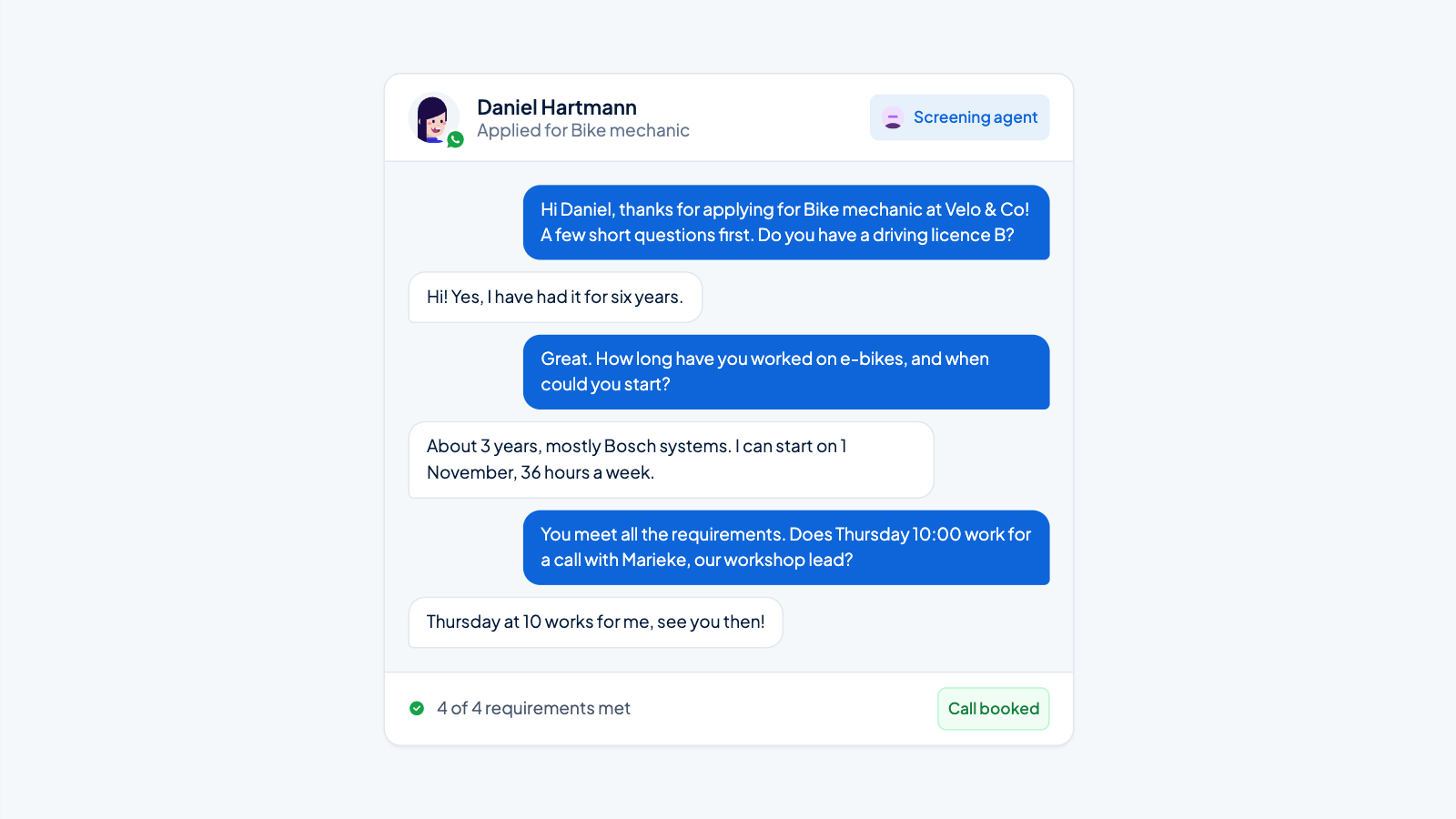
Candidate experience is the total experience an applicant has during a company's entire recruitment process. It includes all interactions from the moment someone sees a job opening through onboarding or rejection. A positive candidate experience leads to better employer branding, increases the likelihood of offer acceptance, and improves your company's reputation in the job market.
A poor candidate experience costs you top talent to competitors
When your application process is slow, unclear, or impersonal, talented candidates lose interest and choose employers that do offer a professional experience. These candidates often share their negative experiences online and with their network, damaging your employer branding and deterring future applicants. By streamlining your recruitment process, providing faster feedback, and using personal communication, you prevent top talent from disappearing to the competition.
Long silences in communication signal disorganization to candidates
Weeks of radio silence after an interview or between different rounds makes candidates feel that your company is poorly organized and doesn't value them. This leads to frustration and causes them to withdraw their application or speak negatively about your company. By setting clear expectations about timing, sending regular updates, and following a structured communication plan, you demonstrate professionalism and respect for applicants' time.
What exactly is candidate experience?
Candidate experience is the sum of all experiences and feelings an applicant has during the entire recruitment and selection process. It starts with the first introduction to your company through a job posting and ends with the onboarding of new employees or the rejection of candidates.
This experience includes various touchpoints: finding and reading the job posting, the application process, communication with recruiters, interviews, feedback moments, and the final decision. Each interaction forms part of the overall impression candidates get of your organization.
A good candidate experience is characterized by clear communication, respectful treatment, transparency about the process, and timely feedback. It's not just about hiring the best candidates, but also about leaving a positive impression on everyone who applies.
Why is candidate experience so important for employers?
Candidate experience directly determines your employer branding and influences your ability to attract and retain top talent. Candidates with a positive experience become ambassadors for your company, while negative experiences damage your reputation and deter future applicants.
A poor candidate experience has measurable consequences for your company. Rejected candidates with a negative experience share their story with an average of 15 people, while those with a positive experience share it with only 3. In the age of social media and review sites like Glassdoor, one bad experience can damage your online reputation for a long time.
Additionally, a positive candidate experience increases the likelihood that top candidates will accept your offer. When candidates feel valued during the process, they are more inclined to choose your company, even if a competitor makes a similar offer. This results in better hiring outcomes and lower recruitment costs.
What are the key components of candidate experience?
The key components of candidate experience are clear job descriptions, a user-friendly application process, transparent communication, respectful treatment during interviews, and timely feedback after each step in the process.
The process starts with the job description. It must be clear about the role, requirements, and what candidates can expect. A well-written job posting attracts the right candidates and prevents unnecessary applications from unsuitable profiles.
The application process itself must be simple and intuitive. Long forms, technical issues, or unclear steps frustrate candidates and can cause them not to complete their application. A streamlined process shows respect for applicants' time.
Communication forms the backbone of a good candidate experience. This means:
- Confirmation of receipt of applications within 24 hours
- Clear information about next steps and timing
- Regular updates on the progress of the process
- Constructive feedback after rejection
- Personal approach instead of standard templates
How do you measure the quality of your candidate experience?
You measure candidate experience by systematically collecting feedback from all applicants through surveys, calculating the Net Promoter Score, and monitoring recruitment metrics such as time-to-hire and acceptance rates.
The most direct way is to send feedback surveys to all candidates who have gone through the process, regardless of whether they were hired or rejected. Ask specifically about their experience with different parts of the process: the job description, the application form, the communication, the interviews, and the feedback.
Key performance indicators you can use are:
- Net Promoter Score (NPS): Measures how likely candidates are to recommend your company as an employer
- Application completion rate: The percentage of candidates who complete the application process
- Time-to-hire: The average time between job posting and offer acceptance
- Offer acceptance rate: The percentage of candidates who accept your offer
- Candidate satisfaction score: Average satisfaction score from feedback surveys
Also monitor online reviews on platforms like Glassdoor and Indeed. These provide insight into how candidates publicly rate your company and which aspects of your recruitment process need improvement.
What mistakes do companies often make with candidate experience?
The most common mistakes are long silences in communication, unclear expectations about the process, impersonal treatment of candidates, and not providing feedback after rejection.
Communication mistakes top the list. Many companies leave candidates waiting for weeks without updates, use only automated messages, or give no feedback after interviews. This makes candidates feel unappreciated and damages your employer brand.
Another common mistake is creating unrealistic expectations. For example, companies promise feedback within a week but make candidates wait a month. Or they indicate that the process has three rounds, but later add extra steps. This inconsistency frustrates candidates and shows a lack of professionalism.
Technical problems in the application process are also often underestimated. A poorly functioning application form, a website that isn't mobile-friendly, or a system that doesn't process resumes properly can cause good candidates to drop out before they can complete their application.
How do you improve candidate experience in your organization?
Improve your candidate experience by creating a structured communication plan, digitizing and streamlining the application process, training everyone involved in candidate communication, and regularly collecting feedback for continuous improvement.
Start by mapping your current candidate journey. Identify all touchpoints from job posting to onboarding and evaluate where candidates encounter problems. This gives you a clear picture of areas for improvement.
Then develop a communication strategy with fixed moments for candidate contact. Ensure automatic confirmations upon application, weekly updates during the process, and personal feedback upon rejection. Use a mix of automated messages for standard updates and personal communication for important moments.
Invest in technology that improves the process for both recruiters and candidates. A good applicant tracking system helps you communicate consistently and not forget any candidates. Also ensure a user-friendly application form that is mobile-optimized.
How Applyfin helps improve candidate experience
At Applyfin, we understand that an excellent candidate experience is crucial for successful recruitment. Our platform centralizes all aspects of the recruitment process and automates communication, enabling recruiters to maintain consistent and timely contact with candidates.
Our solution helps you in several ways:
- Automated communication ensures timely updates and confirmations
- Centralized dashboard prevents candidates from falling through the cracks
- AI-driven workflows speed up the process without loss of quality
- Transparent pipeline gives candidates clarity about their status
- Integrated feedback tools help you monitor the candidate experience
With our technology, recruiters can manage up to 3x more candidates while maintaining a personal experience. Want to know how we can improve your candidate experience? Contact us for a personal demonstration of our recruitment automation features. Discover how you can optimize your recruitment process and attract top talent with Applyfin.