How does AI scoring of applicants work?
AI scoring of applicants automates the evaluation process by using machine learning for faster and more objective candidate selection. The system analyzes resumes, work experience, and skills in minutes instead of days, allowing recruiters to manage three times as many applicants without extra staff. By applying consistent criteria, AI eliminates unconscious bias and improves the quality of your shortlist. Discover the full process from data collection to ranking and learn how to implement it in your recruitment process.

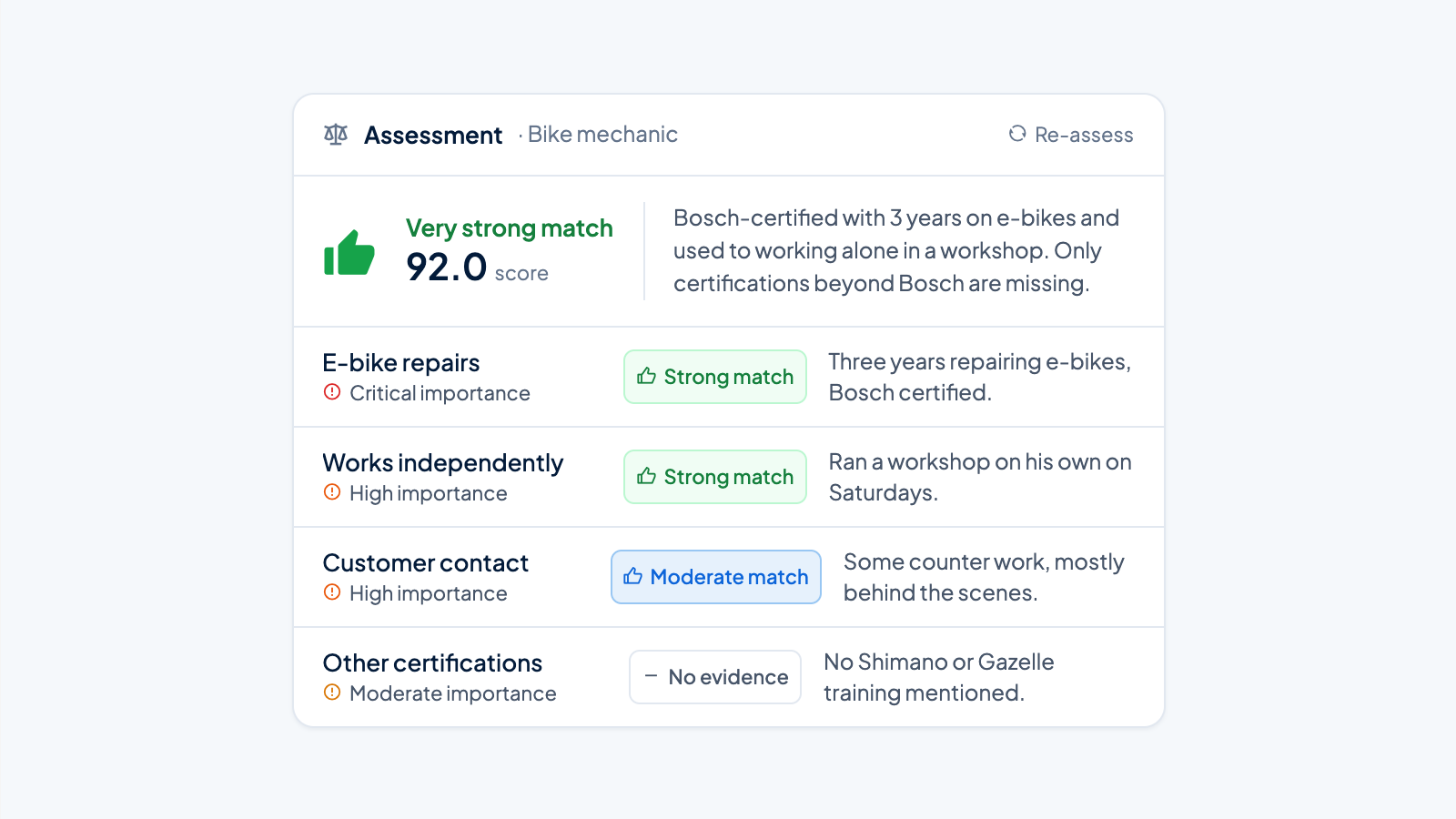
AI scoring of applicants is an automated process in which artificial intelligence assesses candidates based on their resume, experience, and skills. The system analyzes applications and assigns scores that indicate how well a candidate matches a job opening. This makes AI in recruitment processes faster and more efficient, because recruiters immediately see which candidates are most suitable for a role.
What exactly is AI scoring of applicants?
AI scoring of applicants is a technology that uses machine learning to automatically assess and rank candidates. The system learns to recognize patterns from previous successful hires and applies that knowledge to new applications.
Unlike manual screening, where a recruiter reviews each resume individually, AI analyzes hundreds of applications at once. The software evaluates candidates objectively based on predefined criteria and thereby eliminates unconscious biases that can occur in human assessment.
The main difference from traditional methods lies in consistency and scalability. Where a recruiter becomes tired after dozens of resumes and may assess less sharply, AI continues to apply the same standards consistently. This makes AI recruitment tasks more reliable, especially with high volumes of applications.
How does AI scoring work in practice?
The AI scoring process goes through several steps to get from a raw application to a usable candidate score. The system processes information systematically and delivers a structured overview of all candidates within seconds.
The process works as follows:
- Data collection: The system gathers all information from resumes, cover letters, and application forms. Communication via email or other channels is also added to the candidate profile.
- Data processing: The AI analyzes the collected information and extracts relevant data such as work experience, education, skills, and certificates.
- Criteria matching: The system compares the candidate data with the job requirements and assesses the degree of alignment.
- Score generation: Based on all analyses, each candidate receives a score that indicates their suitability for the role.
- Ranking: Candidates are ranked from most to least suitable, so recruiters can immediately see who deserves priority.
Machine learning models evaluate multiple features at once and weight them according to their importance for the specific role. This makes AI in recruitment faster and more accurate than manual assessment.
What criteria does AI use to assess applicants?
AI scoring systems analyze a wide range of factors to arrive at a complete assessment. These criteria are weighted based on their relevance to the specific job opening and organization.
The main assessment criteria are:
- Hard skills: Technical competencies, certifications, and specific knowledge that directly align with the job requirements. The system recognizes programming languages, software knowledge, and field-specific qualifications.
- Work experience: Number of years of relevant experience, types of roles, and industries in which the candidate has worked. Progression in previous roles is also taken into account.
- Education: Education level, field of study, and relevance to the role. The system assesses whether the educational background fits the requirements.
- Soft skills: Indicators of communication skills, teamwork, and leadership qualities that emerge from the way candidates describe their experience.
- Culture fit signals: Language use and values that candidates express in their application, compared with the organizational culture.
- Keyword matching: Presence of specific terms and concepts that are essential for the role.
The system creates a composite score in which all factors are incorporated. This makes AI recruitment tasks more objective and helps recruiters make well-founded decisions.
What are the benefits of AI scoring for recruiters?
AI scoring delivers concrete improvements for recruitment teams struggling with large numbers of applications and tight deadlines. The technology addresses several pain points that recruiters experience daily.
The most important benefit is time savings. Where manually screening a hundred resumes can take days, AI analyzes the same volume in minutes. Recruiters can therefore spend their time on personal conversations with the best candidates instead of administrative screening.
AI also ensures more consistency in assessment. Every candidate is evaluated according to the same criteria, regardless of time of day or workload. This reduces the risk of missed talent due to fatigue or haste.
For small and medium-sized businesses and recruitment agencies, this means they can handle much larger volumes without additional staff. The ability to manage three times as many applicants makes AI recruitment cheaper and more scalable. Teams can run more job openings simultaneously and respond faster to client requests.
Shortlist quality also improves. Through objective data analysis, candidates who might have been overlooked in manual screening come to the surface. This leads to better matches and higher satisfaction for both clients and new employees.
How do you implement AI scoring in your recruitment process?
The shift to automated candidate assessment requires careful preparation and a step-by-step approach. Good implementation ensures your team quickly benefits from the advantages without disrupting ongoing processes.
Start by mapping your current recruitment process. Identify which steps take the most time and where errors arise. This helps you determine where AI scoring can have the greatest impact.
Next, choose a platform that integrates with your existing systems. Our recruitment automation solution centralizes all candidate data and enables seamless integration with your current workflow. This prevents you from having to work with separate systems that do not communicate with each other.
Then set your assessment criteria. Determine which skills, experience, and qualifications are essential for each job category. The system uses these criteria to score candidates. Be specific, but also realistic about what is truly necessary.
Start with a test phase in which you run AI scoring in parallel with your existing process. Compare the results and refine the criteria where necessary. This period also gives your team time to become familiar with the new way of working.
Train your recruitment team on how to use the system. Explain how scores are generated and how to interpret them. AI supports decision-making, but human expertise remains valuable in the final selection.
With full implementation, you will see immediate results in the form of faster turnaround times and higher candidate quality. Many organizations find that AI recruitment processes become not only more efficient but also more enjoyable, because recruiters can focus on personal contact instead of administration.
Want to know how AI scoring can work specifically for your organization? Contact us for a personal consultation. We are happy to help you optimize your recruitment process with smart automation that fits your situation and ambitions.